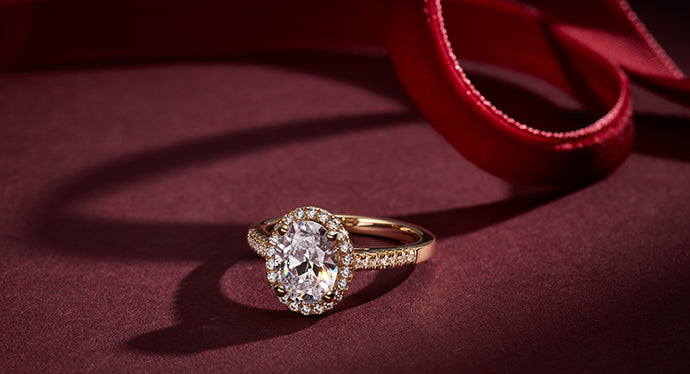


A halo engagement ring is designed to make the centre diamond visually prominent by surrounding it with a border of smaller stones. The effect can be subtle and refined or noticeably glamorous, depending on the size of the halo, the diamond shape, the setting style and the metal.
For New Zealand couples researching engagement rings, the useful question is not simply whether a halo looks impressive in photographs. It is whether the proportions, construction and centre stone work together in a ring that suits personal style and everyday wear.
Understanding those details makes it easier to compare lab-grown diamonds, precious metals and setting options without choosing on sparkle alone.
What Makes a Halo Engagement Ring Different?
A traditional halo places small diamonds around the outline of a larger centre stone. Because the surrounding stones extend the sparkling surface of the ring, the centre can appear broader when viewed from above.
This is different from a solitaire, where almost all visual attention falls on one diamond. A halo creates more detail around the centre and often gives the ring a stronger presence across the finger.
There are several variations. Some designs use a single halo, while others incorporate hidden halos beneath the centre stone. A hidden halo is less obvious from directly above but adds diamond detail when the ring is viewed from the side.
For shoppers comparing halo engagement rings Australia designs with options available to New Zealand buyers, it is worth looking beyond the number of surrounding stones and assessing how the complete setting balances with the centre diamond.
Which Diamond Shapes Work Well With a Halo?
Halo settings can complement many diamond shapes, but the outline of the surrounding stones affects the ring’s overall character.
Round diamonds commonly produce a symmetrical, highly brilliant appearance. Oval centres can create a more elongated look across the finger, while cushion-cut diamonds pair naturally with halos that follow their softly squared outline.
Emerald and radiant cuts can also work well, particularly when the halo reinforces their rectangular shape. Pear and marquise diamonds require more careful setting design because their pointed ends need suitable protection.
The halo does not always have to copy the centre stone exactly. A cushion-shaped halo around a round diamond, for example, can change the apparent outline of the complete ring. That makes the setting itself an important design decision rather than simply decoration around the diamond.
Halo vs Solitaire: Which Style Suits You?
Neither design is automatically better. The choice depends mainly on the amount of detail and visual emphasis you prefer.
| Consideration | Halo Setting | Solitaire Setting |
|---|---|---|
| Overall appearance | Detailed and sparkling | Clean and centre-focused |
| Visual coverage | Usually broader | Mostly determined by centre stone |
| Small accent stones | Common | Usually absent |
| Cleaning | More detailed setting to clean | Generally simpler |
| Style flexibility | Classic to decorative | Minimal to contemporary |
Someone who likes intricate jewellery may naturally prefer a halo. A buyer drawn to restrained designs may find a solitaire more appealing.
There is also a practical difference. More small stones mean more setting points that should be checked periodically, while a simple solitaire contains fewer decorative components.
How Carat Weight and Face-Up Size Affect Appearance
Carat is a measurement of diamond weight, not a direct measurement of visible diameter or surface area. Two diamonds with the same carat weight can therefore look different in size when viewed from above.
That distinction matters with a halo setting because the surrounding diamonds already increase visual coverage. Instead of selecting the centre diamond by carat number alone, compare its actual dimensions and overall proportions.
A well-balanced halo should frame the centre rather than overpower it. If the surrounding stones are visually too large, the centre may lose definition. Very delicate accent stones can create a softer transition, although the craftsmanship needed to secure small diamonds remains important.
What Colour and Clarity Should Buyers Consider?
Colour and clarity should be assessed in relation to the complete ring rather than treated as isolated grades.
A diamond does not necessarily need the highest lab made diamonds clarity grade to look attractive. Many inclusions may be difficult to notice without magnification, although their type and position matter. Buyers should therefore consider how clean the stone appears to the eye as well as what appears on its grading report.
Colour can also interact with metal choice. White metals tend to create a cool visual environment around the diamond, while yellow or rose-toned metals can produce a warmer contrast.
With halo designs, consistency matters too. The centre and surrounding diamonds should look harmonious rather than noticeably mismatched.
Lab-Grown Diamonds and Halo Settings
Lab-grown diamonds can be used in halo engagement rings in the same types of fine-jewellery settings used for mined diamonds. They are diamonds with the same fundamental crystal material, although their origin differs.
For buyers considering a lab-grown centre stone, the normal evaluation factors still matter: cut quality, dimensions, colour, clarity and an appropriate grading report.
The setting deserves equal attention. Pavé work around a halo involves numerous small stones, so neat alignment, secure setting and consistent spacing contribute significantly to the finished appearance.
This is particularly relevant for bridal sets, where the engagement ring and wedding band must also sit together comfortably. A large or low-positioned halo can affect how closely a straight wedding band fits beside the engagement ring.
Check the Ring From More Than One Angle
Online photographs often emphasise the top view because that is where the halo creates the strongest visual impact. The side profile can reveal just as much about how the ring will wear.
Before deciding on a design, examine the height of the centre setting, how exposed the diamond appears, whether the halo projects significantly beyond the band and how a wedding ring is expected to sit beside it.
Also consider everyday habits. Higher settings may provide a dramatic profile but can be easier to catch on clothing or other objects. Lower settings may feel more compact, although their structure can limit wedding-band compatibility.
New Zealand shoppers researching lab-grown bridal jewellery through resources such as novitadiamonds.co.nz can use these construction details to compare rings on more than centre-stone specifications alone.
Choose Proportion Before Maximum Sparkle
The strongest halo designs usually look intentional as a complete piece of jewellery. The centre diamond remains identifiable, the accent stones create definition without unnecessary visual competition, and the band provides enough balance for the ring to look coherent from every angle.
Before ordering, check the centre diamond’s dimensions, grading information, halo proportions, metal, setting profile and wedding-band compatibility. If customisation is available, consider how small changes to halo size or band width could alter the finished appearance.
A halo should enhance the diamond rather than compensate for a poorly chosen one. Selecting the centre stone and setting together is therefore more useful than treating them as two separate purchases.